See also: wholesale wood pellets for Italy.
Italy has one of the longest-established and most demanding residential pellet stove markets anywhere in Europe. For wholesale distributors supplying Italian retailers, installers and hardware stores (ferramenta), that maturity cuts both ways: it means deep, reliable underlying demand, but also a customer base that notices inconsistency between shipments immediately. This guide looks at Italy's pellet stove market, how distribution actually works on the ground, what "premium" really means to an Italian buyer, and what to expect shipping from Portugal.
Italy's Pellet Stove Market: Deep Roots, High Expectations
The pellet stove (stufa a pellet) is a standard heating appliance across much of northern and central Italy — Lombardy, Veneto, Piedmont and Emilia-Romagna in particular — where the appliance has been mainstream for long enough that Italian consumers and installers are unusually well informed about fuel specification compared with newer pellet markets elsewhere in Europe. It's genuinely common for an Italian buyer to ask specific questions about fines content, mechanical durability, or ash behaviour in a particular stove model — not just price and diameter. Supplying this market well means treating specification consistency as a baseline requirement, not a marketing claim.
Beyond stoves, Italy also has meaningful demand for central-heating pellet boilers in both residential and small commercial buildings, which adds big-bag and bulk-tanker volume to a market that might otherwise be assumed to run mostly on small retail bags.
How Distribution Actually Works in the Italian Market
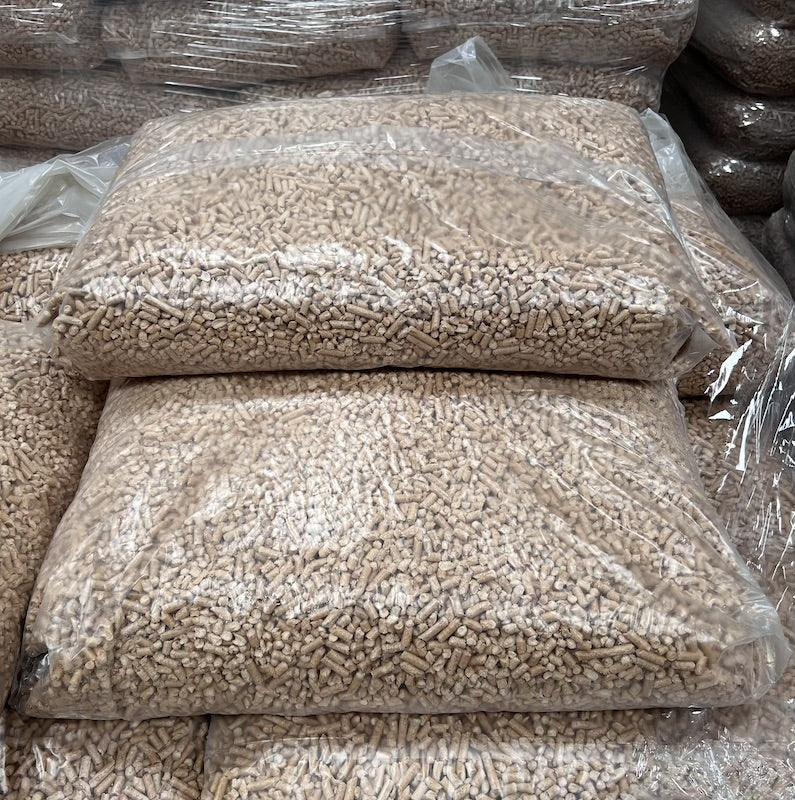
Italian wholesale distribution runs primarily through two channels. The retail and hardware-store channel (ferramenta, home and garden centres) moves 15 kg bags on pallets to end consumers buying fuel for their own stove, typically in volumes that build through the autumn and hold through the winter heating season. The installer channel, supplying central-heating pellet boiler customers, orders in one-tonne big bags matched to forklift-equipped delivery and storage setups. Distributors serving both channels from a single import typically order a mixed truckload or container, splitting bagged and big-bag product to match downstream demand without running two separate supply relationships.
Regional distribution structure also matters in Italy more than in some other markets, given the country's geography. Northern regions close to the Alpine border — Piedmont, Lombardy, Veneto, Trentino-Alto Adige — represent the deepest and most established pellet stove demand, often supplied through regional wholesalers who also handle Austrian and Swiss import product alongside Portuguese supply. Central Italian distributors, further from both the northern border and southern ports, typically plan around slightly longer lead times, and increasingly favour short-sea container shipment for cost efficiency over road freight via France.
What “Premium” Actually Means to Italian Buyers
Given how established the Italian market is, "premium" isn't a vague marketing term to most buyers here — it maps to specific, checkable numbers: diameter held tightly to 6 mm, moisture consistently below 10%, ash content below 0.7%, and low fines content that won't clog an automated feed auger or generate dust during bag handling. Mechanical durability — how well a pellet resists breaking apart during transport and handling — matters more for Italian shipments than for some closer markets, simply because the transit distance from Portugal, whether by road via France or by short-sea container shipment, is longer than a domestic Italian supply chain. We test every production batch for these properties before packing and keep batch-level records, so any delivery can be traced back to its exact production run if an Italian distributor ever has a specification question.
Shipping Routes: Road via France or Short-Sea to Italian Ports
Italian orders move in one of two ways. Road freight, transiting France, suits regular smaller-volume distributors who want flexible scheduling and the ability to receive smaller, more frequent truckloads rather than committing to full container volumes. Short-sea container shipment from Porto / Leixões into Genoa, La Spezia or Livorno often works out more economical for larger-volume buyers, particularly those placing standing orders ahead of the autumn restocking period, since a single container consolidates freight cost more efficiently than several smaller road shipments over the same period.
Whichever route you choose, we recommend factoring moisture protection into the decision for longer routes: pellets are sensitive to moisture pickup, which can cause swelling and breakdown into fines if bags are exposed or damaged in transit. We load under cover as standard, and for the longer Italy route specifically, we recommend moisture-protected big bags over standard palletised bags where the order size allows it.
Trade Terms Between Portugal and Italy
As fellow EU member states, Portugal and Italy trade under single-market rules — shipments move without customs declarations or import duty, with only standard intra-community VAT treatment applying. This keeps landed-cost comparison against domestic Italian production and other European suppliers straightforward, without the additional customs planning step that a non-EU import would require.
Technical Specification for the Italian Market
Every batch supplied to Italian customers is produced to ENplus A1-equivalent specification: 6 mm diameter, length 3.15–40 mm, moisture content below 10%, ash content below 0.7%, calorific value 4.8–5.3 kWh per kilogram, and bulk density of approximately 650 kg per cubic metre.
Placing a Wholesale Order for the Italian Market
Given how quality-literate Italian buyers tend to be, we recommend new distributors request a current specification sheet and a sample bag or two to test against your own stove or boiler models before committing to a full truckload or container. From there we confirm shipping route — road via France or short-sea container — packaging format, and prepare documentation ahead of loading, typically with lead times of two to four weeks depending on route and season.
Comparing Portuguese Import Pellets Against Italian and Austrian Domestic Supply
Italy has both its own domestic pellet production and well-established import relationships with Austrian producers, given the shared border and mountain-region demand overlap. For a Lombardy or Piedmont-based distributor already buying from Austria, Portuguese pellets represent a genuine second-source option — different production region, same ENplus A1-equivalent specification, and a price structure shaped by different input costs and freight economics. Many of our Italian customers use Portuguese supply specifically to diversify away from single-region dependence, particularly useful when Alpine transport routes face winter disruption that can affect Austrian deliveries.
Storage Recommendations for Italian Distributors
Northern Italian winters can be genuinely cold and, in some regions, damp, so standard moisture-protection storage practice applies: bagged pellets on pallets in dry, covered warehouse space; big bags kept off bare ground with forklift access preserved; and, for the relatively few Italian buyers at bulk-tanker scale, a dedicated silo with sealed discharge. Given the longer transit distance from Portugal compared with domestic or Austrian supply, we particularly recommend Italian distributors inspect bags on arrival for any transit damage before moving stock into long-term storage.
Working With Our Export Team
Because shipping route, packaging format and delivery point all affect final delivered price, we quote Italian orders through direct conversation with our export team. This lets us recommend the most cost-effective route for your specific location — road via France or short-sea container into Genoa, La Spezia or Livorno — and confirm current ENplus-equivalent documentation ahead of your first order.
Seasonal Order Planning for the Italian Market
Given Italy's strong and early-starting heating season in northern regions, we recommend Italian distributors place an initial forward order by July or early August, ahead of the autumn rush when both Portuguese production capacity and European freight availability tighten. A smaller top-up order in November, once the season's actual demand pattern is clearer, completes a typical annual ordering cycle for our regular Italian customers.
Frequently Asked Questions
Frequently Asked Questions
What makes the Italian pellet stove market different from other European markets?
Italy has one of Europe's longest-established residential pellet stove cultures, particularly in northern and central regions, resulting in a customer base that is unusually specification-literate and quick to notice inconsistency between shipments.
How are pellets shipped from Portugal to Italy?
Either by road, transiting France, which suits regular smaller-volume distributors, or by short-sea container shipment from Porto / Leixões into Genoa, La Spezia or Livorno, which often suits larger standing-order volumes.
What does 'premium' pellet quality mean for Italian pellet stove buyers?
Tightly held 6mm diameter, moisture consistently below 10%, ash below 0.7%, low fines content, and high mechanical durability so pellets arrive intact after the longer transit distance from Portugal.
Is customs duty payable between Portugal and Italy?
No. Both are EU member states, so wood pellets move under single-market rules with no customs duty or import declarations — only standard VAT applies.
Can you supply both bagged and big-bag pellets on the same shipment to Italy?
Yes, we regularly supply mixed truckloads or containers combining 15 kg bagged pellets for the retail channel and one-tonne big bags for installer customers, on a single delivery.